Getting Married on a Florida Beach? Check the Permit Rules First
Florida beaches are public, and each city or county sets its own rules for weddings. Here is what Clearwater, Panama City Beach and Martin County require, how sea turtle season affects your plans and what to check before you book.
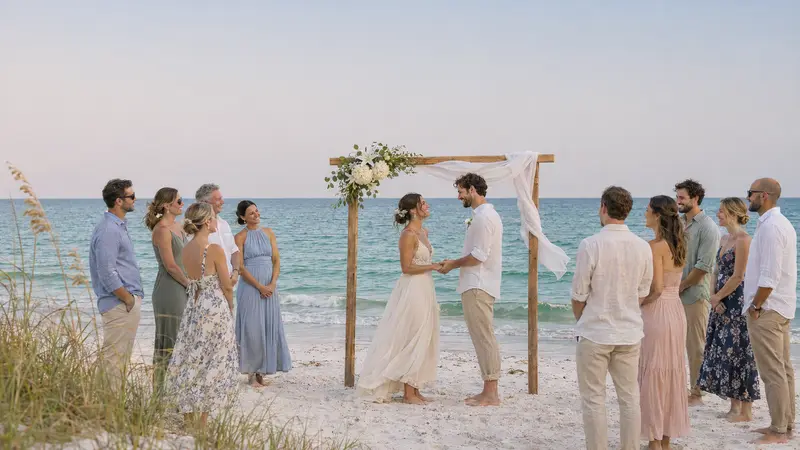
A ceremony with your toes in the sand is one of the most popular ways to marry in Florida. But Florida beaches are public, and each one is managed by a city, a county or the state, with its own rules. Some small ceremonies need only a quick notice. Others need a paid permit applied for weeks ahead. Here is what three local governments require, and what to check wherever you plan to say "I do."
First, find out who manages your beach
Before you book, confirm whether your spot is inside city limits, county land or a state park. The rules, the fees and the office you apply to depend on it.
Three examples of local rules
Clearwater (Pinellas County)
A beach ceremony permit is required if your event has more than 25 people, uses a small arch, chairs or a 10-by-10 tent, has amplified sound, or generates income from attendees.
Permits must be requested at least two weeks in advance and no more than a year ahead.
Each permit covers a four-hour window, including setup and cleanup, and must end by sunset.
Ceremonies take place on a public beach: you cannot block off an area, and everything must be removed right after.
Panama City Beach (Bay County)
Weddings with 40 or fewer people, including the wedding party, are free, but the city must be notified in writing.
For 41 to 100 people, you need a beach wedding permit, submitted at least 14 days ahead, with a $50 processing fee.
For more than 100 people, you need a special event permit, which takes longer to review.
Receptions, food and drinks other than water, confetti, rice, glitter, tiki torches and fixed lighting are not allowed, and ceremonies must stay at least 100 feet from any marked sea turtle nest.
Keep reading for free
Create your free MarryCast account to read the whole story, save stories and vendors, and request quotes.
Martin County
Ceremony permits are available for unguarded beaches and select park areas, for up to five hours between sunrise and sunset.
Because of sea turtle season, no permits are issued for any time after sundown from March 1 to October 31.
Balloons, glass containers and personal grills are not allowed. Full payment is due within 48 hours of reserving.
Sea turtle season
Florida beaches are important nesting grounds for threatened and endangered sea turtles. According to the Florida Fish and Wildlife Conservation Commission (FWC), turtles typically begin nesting in March along the southeast Atlantic coast, from Brevard to Broward County, and in April or May on the Gulf Coast and in North Florida. Lights on the beach can disorient nesting turtles and hatchlings, so FWC asks beachgoers to keep the beach dark at night and use flashlights or phones only when needed. Expect local rules on evening ceremonies and lighting during these months.
What to check before you book
Who manages the beach, and which office issues the permit.
Whether your guest count, arch, chairs or sound system require a permit.
How far in advance you must apply, and the fee.
Time limits, including setup and cleanup, and whether you must finish by sunset.
What is not allowed, such as receptions, alcohol, balloons, confetti or lighting.
Sea turtle rules for your date, and a plan B in case of rain.
With the right permit in hand, you can relax and enjoy the view.
Sources
- City of Clearwater, Get a beach ceremony permit
- City of Panama City Beach, Get married on the beach
- Martin County, Beach and park wedding ceremony permits
- Florida Fish and Wildlife Conservation Commission, FWC shares tips to protect nesting sea turtles (Mar. 17, 2026)